
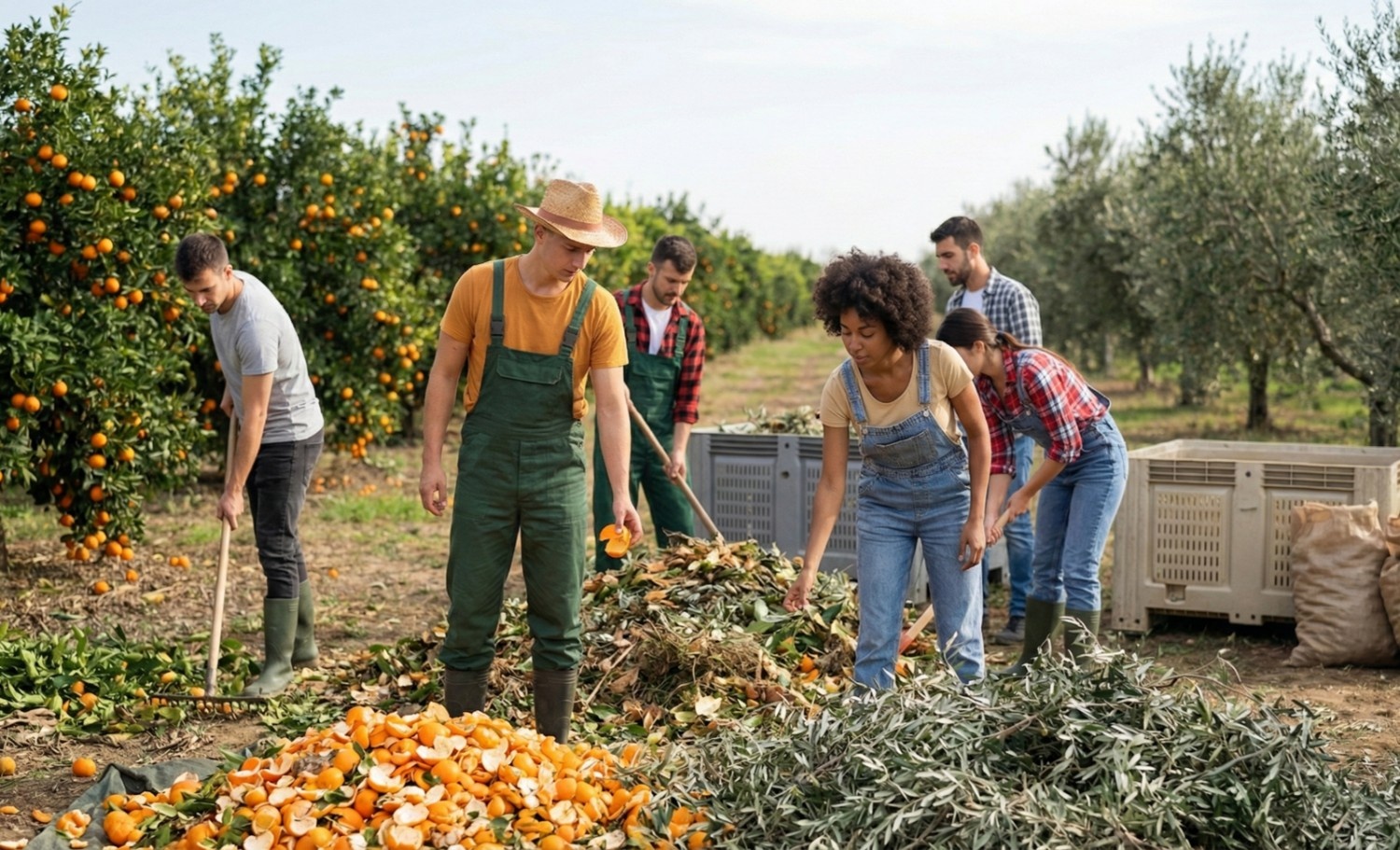
ORIENTATE: Transforming Agricultural Waste into Environmental and Economic Benefits Across the Mediterranean
From 3–4 February 2026, the ORIENTATE project officially launched in Amman, Jordan, uniting partners from Italy, Spain, Jordan, Turkey, and Lebanon with the shared goal of transforming agricultural waste into valuable products.
The event is held under the patronage of H.E. Dr. Saeb Khraisat, Minister of Agriculture of the Hashemite Kingdom of Jordan, and will be honored by H.E. Ambassador Pierre-Christophe Chatzisavas, Head of the Delegation of the European Union to Jordan, underscoring the strategic importance of Jordan–EU cooperation in advancing sustainable and circular agricultural systems. The opening ceremony will also feature H.E. Dr. Nedal Al-Ouran, Head of the Jordanian Delegation to the Interreg NEXT MED Programme and Commissioner of Environment and Public Safety at ASEZA, alongside Dr. Esmat Al-Karadsheh, Coordinator of the Interreg NEXT MED Eastern Mediterranean Branch Office, highlighting the programme’s long-standing record of successful regional collaboration.
Agricultural waste is one of the key challenges facing the Mediterranean region today. The sector generates large volumes of residues, such as olive pomace, grape marc, pruning biomass, and greenhouse plastics, associated with the region’s dominant agricultural practices. These waste streams are often seasonal and concentrated in short periods, making their management particularly complex. When improperly managed, agricultural waste can cause serious environmental impacts, including air pollution, soil degradation, water contamination, and increased greenhouse gas emissions. These effects are especially critical in the Mediterranean context, where ecosystems are already stressed due to water scarcity and climate change.
Despite the strong potential of agricultural residues to be transformed into valuable resources through circular economy approaches, not all Mediterranean countries have fully implemented such models in the agricultural sector. In this context, Turkey, Jordan, and Lebanon have expressed significant interest in adopting circular economy solutions already tested in EU countries such as Italy and Spain, including innovative processes, technologies, and practices aimed at improving agricultural waste management and resource efficiency.
This challenge has been widely highlighted in international analyses by FAO and UNEP, which emphasize both the environmental risks of agricultural waste mismanagement and the considerable potential of circular economy solutions in Mediterranean agri-food systems.
Addressing agricultural waste through sustainable and circular strategies is therefore essential to reduce environmental impacts, strengthen resilience in the agri-food sector, and unlock new economic opportunities across the Mediterranean region.
ORIENTATE will directly benefit farmers, agri-businesses, and local communities by promoting circular economy practices in the citrus and olive sectors. Farmers and agricultural operators will gain practical skills and adopt technologies to transform waste into valuable bio-products, enhancing income and resource efficiency. Agri-businesses and feed manufacturers will benefit from technology transfer, innovation opportunities, and collaboration with EU experts, boosting competitiveness. Local communities and public authorities will experience environmental improvements through reduced waste, CO₂, and methane emissions, while also gaining access to locally produced bio-products and new green job opportunities.
By engaging over 400 participants through communication, job-shadowing, pilot testing, training, and scaling-up activities, ORIENTATE ensures knowledge exchange, policy support, and the widespread adoption of sustainable agricultural practices, generating measurable social, economic, and environmental impact.
The ORIENTATE project brings together six partners from Italy, Spain, Jordan, Turkey, and Lebanon, all working collaboratively to turn citrus and olive waste into valuable products while promoting sustainable farming and business practices across the Mediterranean:
- ARCES (Italy) oversees project management and facilitates knowledge sharing across all participating countries.
- CORERAS (Italy) and LCE (Spain) provide technical expertise, support the testing of innovative solutions, and train local professionals.
- NARC (Jordan) and KSU (Turkey) implement circular economy practices in real agricultural and industrial settings to validate effective solutions.
- PDA (Lebanon) helps scale up successful approaches and ensures their sustainable adoption by local communities, businesses, and authorities.
The six ORIENTATE partners, alongside leaders from ten other EU-funded projects (MedRESOURCE, C’est la Vie, LIFE LowCarbon Feed, LIFE OLEA REGENERA, FAB’LIM, UNIDO 2Circular, OLIWA, SMART-UP, AKYAS Agri-Tech, SuChAQuality), will showcase their strategies to advance the circular economy through agricultural waste valorization.
The ORIENTATE project has a total budget of €2.5 million, with 89% funded by the European Union through the Interreg NEXT MED Programme. We acknowledge the financial support from the European Union under the Interreg NEXT MED Programme, Grant Contract A_T_2.4_0443 ORIENTATE, Prot. No. 3419 dated 11/12/2025.
Media Contacts
https://www.interregnextmed.eu/project-page/orientate/about/
- Ms. Clelia Giordano (Communication Manager) –
Email: communication.orientate@arces.eu / Tel: +39 091 346629
- Mr. Alessandro Pernice (Project Coordinator)
E-mail: a.pernice@arces.it / Tel: +39 3461630404
This press release has been produced with the financial assistance of the European Union under the Interreg NEXT MED Programme. The contents of this document are the sole responsibility of ARCES Association and cannot under any circumstances be regarded as reflecting the position of the European Union or the Programme management structures.
ORIENTATE_A_T_2.4_0443_Press_Release_KoM_ARCES_NARC_28_01_2026