
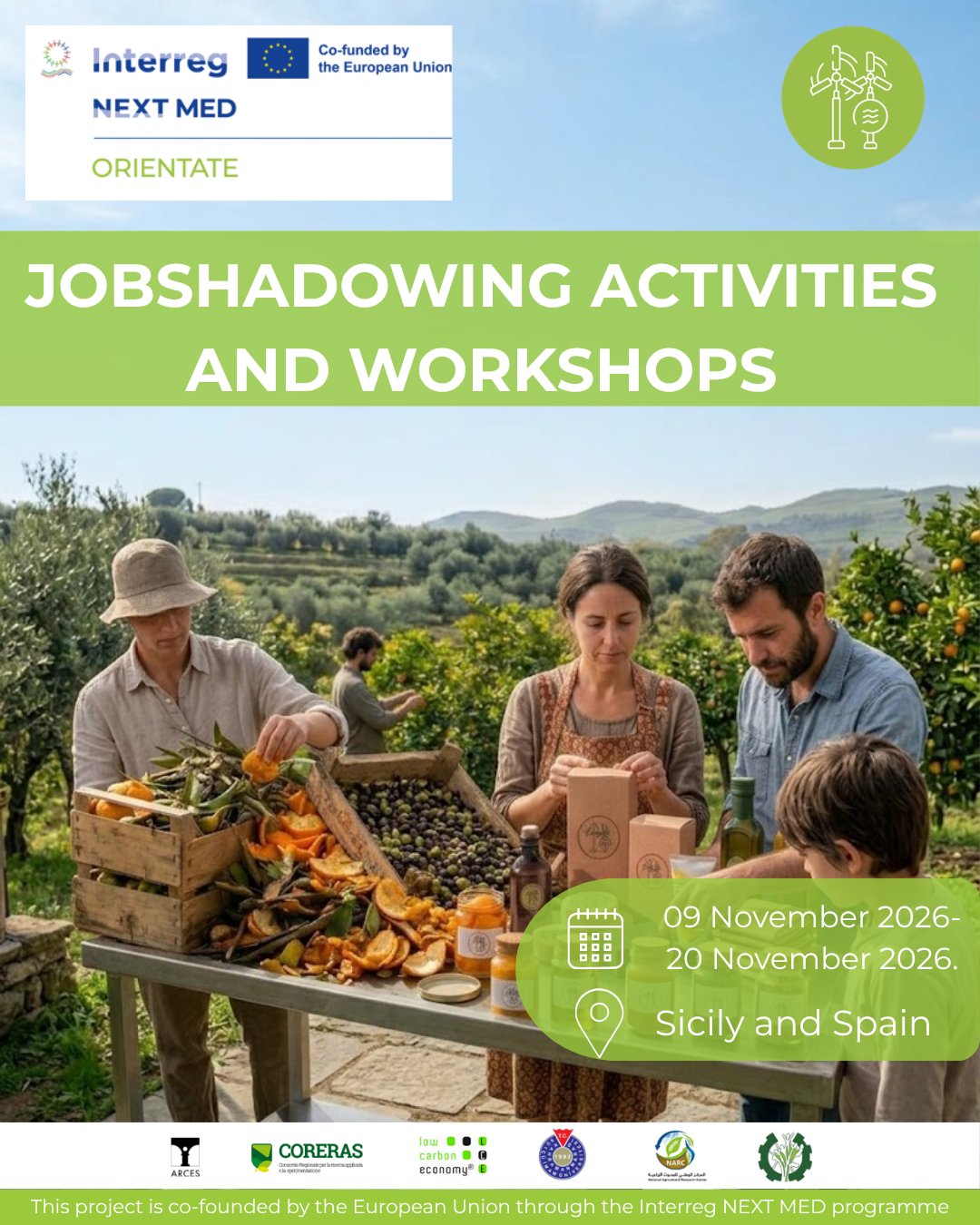
From 9 to 20 November 2026, the ORIENTATE – tOwaRds cIrcular Economy iN The AgriculTural project will organise two job-shadowing experiences in Sicily and Spain. International delegations will take part in a programme of study visits, knowledge exchange and peer learning, exploring the opportunities that the circular economy offers to the agri-food sector.
The activities will focus on the citrus and olive value chains, with the aim of exploring how agricultural by-products can be recovered and transformed into valuable resources. Two thematic workshops, one in Italy and one in Spain, will complement the visits, providing opportunities for the delegations to discuss the experiences gained, plan future pilot projects and assess the job-shadowing activities.
Sicily: two thematic pathways focusing on citrus and olives
From 9 to 13 November, Sicily will host two thematic pathways dedicated to strategic value chains for the region: the citrus value chain in the Palermo area and the olive value chain in the Catania area.
In the Palermo area, the visits will focus on citrus processing and the recovery and valorisation of processing residues. The programme will include visits to SunRise Citrus (Carini), Bioroman (Termini Imerese), Società Agricola Assoro Biometano and Pandittaino – Valle del Dittaino. Particular attention will be given to waste reduction and the efficient use of resources.
In the Catania area, the programme will explore the olive value chain, from olive oil production to the management and valorisation of olive pomace and other processing residues. The delegations will meet Bionap, Oleificio Consoli, Mangimi Di Pasquale, the Distretto Produttivo della Filiera della Carne Siciliana and Azienda Zirone Curcio. These visits will provide an opportunity to explore potential uses for agricultural by-products and identify synergies between different production activities.
The Sicilian activities will conclude on 13 November 2026 with a workshop hosted by ARCES in Palermo. Delegations from Italy, Spain, Türkiye, Jordan and Lebanon will compare the experiences gained during the visits in the Palermo and Catania areas and work on the report covering the delegations involved in the Sicilian job-shadowing activities.
The workshop will also provide an opportunity to lay the groundwork for future pilot projects and jointly assess the activities carried out. A question-and-answer session and a final exchange of views will round off the meeting.
Spain: exchanging experiences to develop new solutions
From 14 to 20 November, the activities will continue in Spain, where both delegations will take part in a further learning and exchange programme. The visits will showcase local experiences and build on the knowledge gained in Sicily, encouraging dialogue and the identification of solutions suited to different Mediterranean contexts.
In the Valencia area, the visits will focus on citrus processing, scientific research and technological innovation for the valorisation of agri-food by-products. The programme will include Zuvamesa (Sagunto), a citrus processing plant; IATA-CSIC – Institute of Agrochemistry and Food Technology (Paterna); and the technology centre AINIA (Paterna).
Particular attention will be given to discussions with technicians, researchers and experts on the circular economy and by-product recovery, as well as to exploring the connections between production, research and innovation.
On 18 November 2026, a workshop will take place at LCE in Vall d’Uixó. The meeting will focus on sharing the outcomes of the visits, preparing the report on the delegations involved in the Spanish job-shadowing activities and planning the next steps. A question-and-answer session and a final exchange of views will also be included.
Mediterranean cooperation for a more circular agri-food sector
Through these study visits and opportunities for exchange, ORIENTATE aims to strengthen cooperation among the participating delegations and promote knowledge and experience in the valorisation of agricultural by-products.
The job-shadowing activities will provide a practical opportunity to compare different approaches and practices, identify new opportunities for cooperation and contribute to the development of future pilot projects. By fostering knowledge exchange across Mediterranean countries and connecting production, research and innovation, the project will support the transition towards more sustainable and circular production models in the Mediterranean agri-food sector.